
Fluency tips
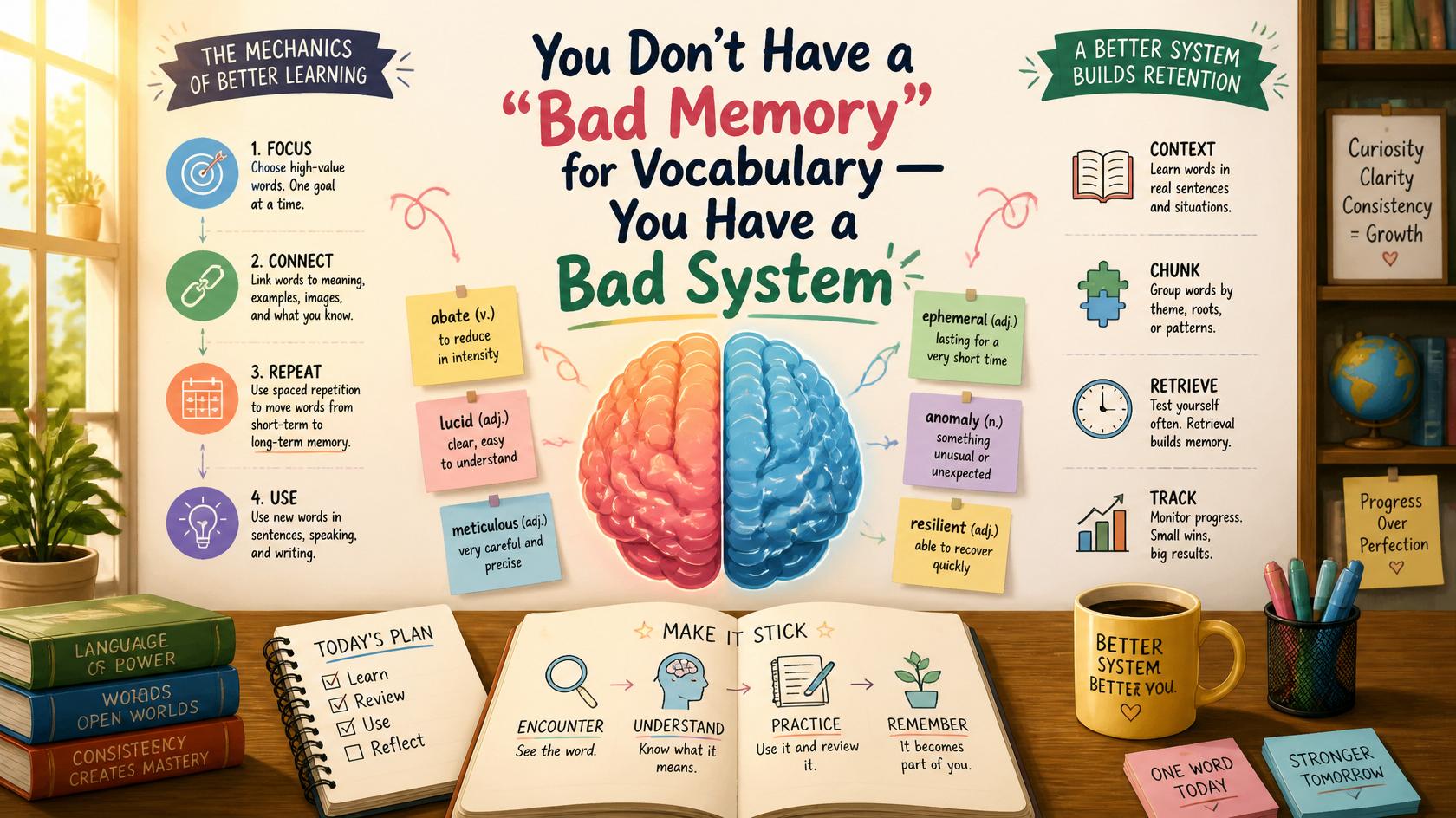
You Don't Have a "Bad Memory" for Vocabulary — You Have a Bad System
The “Unlearn English” Series (Post 12 of 12)
“You didn't fail to remember the word. Your system failed to ever store it properly in the first place.”
You Don't Have a “Bad Memory” for Vocabulary, You Have a Bad System
“I just have a terrible memory for languages” is one of the most common, and most wrong, explanations learners give for stalled vocabulary growth. It's wrong because it locates the problem inside a fixed trait, when the actual cause is almost always an external, fixable process failure: reviewing words once and never again, cramming lists the night before a test, or relying on passive recognition instead of active recall. None of that is a memory problem. It's a systems problem, and blaming your brain lets a broken method off the hook entirely.
What the memory research actually shows. Human memory doesn't fail randomly, it fails predictably, according to a well-documented forgetting curve: information reviewed once decays rapidly within days unless it's revisited at increasing intervals. This isn't a flaw specific to “bad” memories. It's how all memory works, for everyone, including people who consider themselves excellent language learners. The people who seem to “just remember” vocabulary easily are, almost without exception, unconsciously reviewing it more often, in more varied contexts, than the people who give up and declare their memory broken.
Why the “bad memory” story is so appealing anyway. It's a comfortable, permanent-sounding excuse. “I have a bad memory” requires no further action and closes the conversation. “I've been reviewing words the wrong way” requires admitting the method needs to change, which is a much less comfortable, but far more solvable, problem. The first story protects self-image. The second one actually fixes the vocabulary gap.
What a working system actually looks like. Spaced repetition, reviewing a word at increasing intervals right as you're about to forget it, reliably outperforms cramming or one-time review in study after study, for learners who consider themselves to have great memories and terrible ones alike. Active recall, forcing yourself to produce the word rather than just recognizing it on a flashcard, builds retention that passive review never does. Neither of these techniques requires a special kind of brain. They require a system most learners were simply never taught.
The uncomfortable but freeing conclusion. If vocabulary keeps slipping away, the problem was never your memory. It was a review schedule that ignored how forgetting actually works, and a method that relied on recognition instead of recall. Fix the system, spaced, active review, and the “bad memory” disappears, because it was never really there.