
Things We Probably Need to Rethink
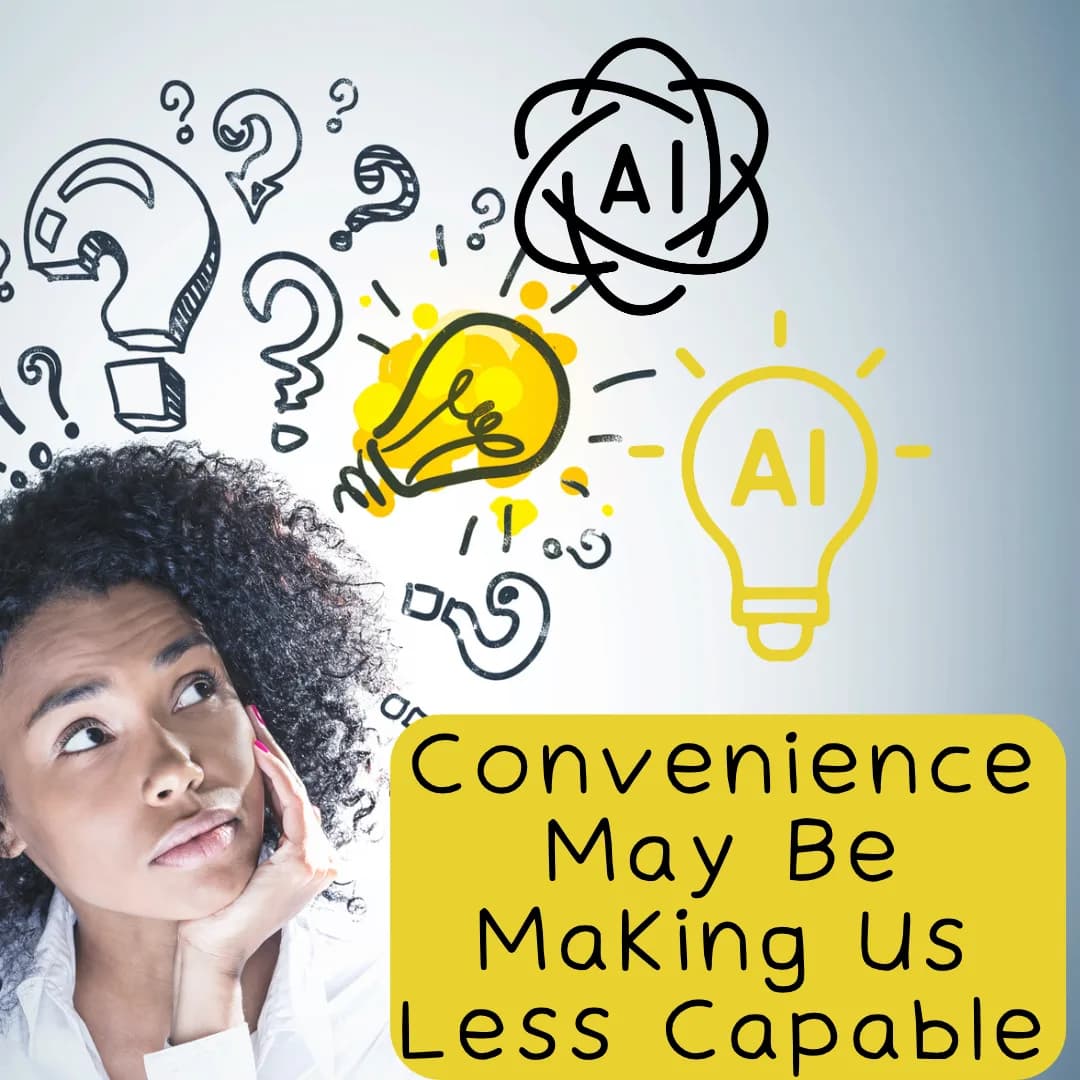
Convenience May Be Making Us Less Capable
Things We Probably Need to Rethink
Do you know your best friend's phone number? Can you find your way across your own city without a map app?
If your phone disappeared today, what would you still be able to do?
As AI tools write, summarize and decide for us, researchers are asking a new question: what happens to our thinking when machines do the work? A 2025 survey by Microsoft and Carnegie Mellon researchers, covering 319 knowledge workers, is one of the first to look.
10-SECOND VERSION: Early research suggests that heavy reliance on GPS and maybe on AI, can be linked to weaker skills. But the research is young, and the picture is mixed. It is a fact, not a maybe.
In a three-year follow-up, heavier GPS users showed a steeper decline in spatial memory, and they had not started out with a poor sense of direction.
What People Say....
Convenience is progress. Machines do the boring work, so we can do better things.
Research
In 2020, researchers Louisa Dahmani and Véronique Bohbot tested 50 regular drivers. People with more lifetime GPS use had worse spatial memory when they had to find their way without GPS. A small follow-up of some of the same people over three years found that greater GPS use went with a steeper decline in spatial memory. Importantly, people who used GPS more did not do so because they felt they had a poor sense of direction.
In 2025, researchers at Microsoft and Carnegie Mellon surveyed 319 knowledge workers about 936 real examples of using generative AI at work. The more people trusted the AI, the less critical thinking they reported. The more confident they were in their own skills, the more critical thinking they reported. Their work shifted toward checking, combining and supervising.
This survey is based on self-reports, so it shows a link, not proof of damage.
Use it or lose it? The honest answer: sometimes yes, sometimes no.
The Usual Blah, Blah, Blah
We say “convenience” as if it has no cost. But every task we hand over is a skill we stop practising. For some skills (long division, for example) that may be fine. For others, such as judgment and memory for places, we may care more than we think.
That is my opinion, not a study result.
Experience
A student asks an AI for the summary of a book, then for an essay outline, then for the essay. The result is excellent. A week later, he cannot explain a single idea from it.
My Question
Which skills am I happy to hand over, and which do I want to keep?
On the Other Hand
Convenience also gives us time and helps people who struggle. GPS helps people with poor eyesight or anxiety, and AI can help people with dyslexia to write.
And the story is not simple. Another 2025 analysis of older adults, by Benge and Scullin, found that digital technology use was linked to a lower risk of cognitive impairment. That suggests technology may also protect the brain. Whether generative AI follows the GPS pattern is still an open question.
The Stark Reality - Truth
Heavy reliance on tools can weaken the skills they replace. That is supported for GPS, and it is an early idea for AI. But the effect depends on how we use the tools.
The Significance
What does it promise? That convenience only gives and never takes.
What does the evidence show? That heavy GPS use is linked to weaker spatial memory, and that more trust in AI is linked to less self-reported critical thinking.
What should you do? Decide which skills you want to keep, and practise them on purpose.
Be Brave.
This week, do one thing the hard way on purpose: find a route, remember a number, or write the first draft yourself.
Frequently Asked Questions
Does GPS make your memory worse?
Research suggests that heavy GPS use is linked to weaker spatial memory when you navigate without it. A small three-year study found a steeper decline in heavy users, but more research is needed.
Does AI make you less intelligent?
There is no proof of that. A 2025 survey found that people with more confidence in AI reported less critical thinking, but the data were self-reported and do not prove lasting harm.
What is cognitive offloading?
It means using tools (notes, calendars, search, AI) to do mental work for you. It can be useful, but it may also weaken skills that you stop practising.
How can I use AI without losing my skills?
Try the task first, then use AI to check or improve it. Always verify AI answers, and keep practising the skills you value.
English Lesson: Talking About Tools and Skills
Every article on this blog is also an English lesson. Read slowly, say the new words out loud, and use them today.
New Words
convenience (noun) means something that makes life easier and saves effort. Online shopping is a great convenience.
capable (adjective) means able to do something well. She is a capable manager.
rely on (phrasal verb) means to depend on someone or something. I rely on my phone for directions.
navigate (verb) means to find your way. He navigated through the old town.
skill (noun) means an ability that you learn and practise. Writing is a useful skill.
offload (verb) means to give a task or job to someone or something else. I offload my reminders to my calendar.
Say This, Not That
Say “I rely on my phone for directions, but I'm learning the route.”
Don't say “I'd be completely lost without my phone.”
Why? The first sentence shows a plan to keep a skill.
Say “Let me try first, then I'll check with the app.”
Don't say “Just let the AI do it.”
Why? Trying first keeps your thinking active.
Say “I want to keep this skill.”
Don't say “Why bother learning it?”
Why? Choose what to keep. Don't let the tool choose for you.
Grammar Spotlight: the first conditional and unless
Use the first conditional for real possibilities in the future.
If + present simple, will / may / might + base verb
If you use GPS every day, your spatial memory may decline.
Unless you practise, you will lose the skill. (Unless = if not)
Common mistake: Do not use will in the if-part.
Incorrect: If I will have time, I will walk.
Correct: If I have time, I will walk.
Quick Practice
If you ___ GPS every day, you may lose the skill. (use / will use)
___ you practise, you will forget. (If / Unless)
Fix the mistake: If I will have time, I will walk.
Answers: 1. use · 2. Unless · 3. If I have time, I will walk.
Enjoyed this lesson? Subscribe to English with Sue and become an active student. Every article gives you new words, useful phrases and one grammar point. Today's challenge: write one sentence with a new word and say it out loud.
More in Things We Probably Need to Rethink
View allMore articles

We Have More Information and Less Knowledge
We Don't Have an Attention Problem. We Have a Meaning Problem
Your Algorithm Knows You Better Than Your Friends Do