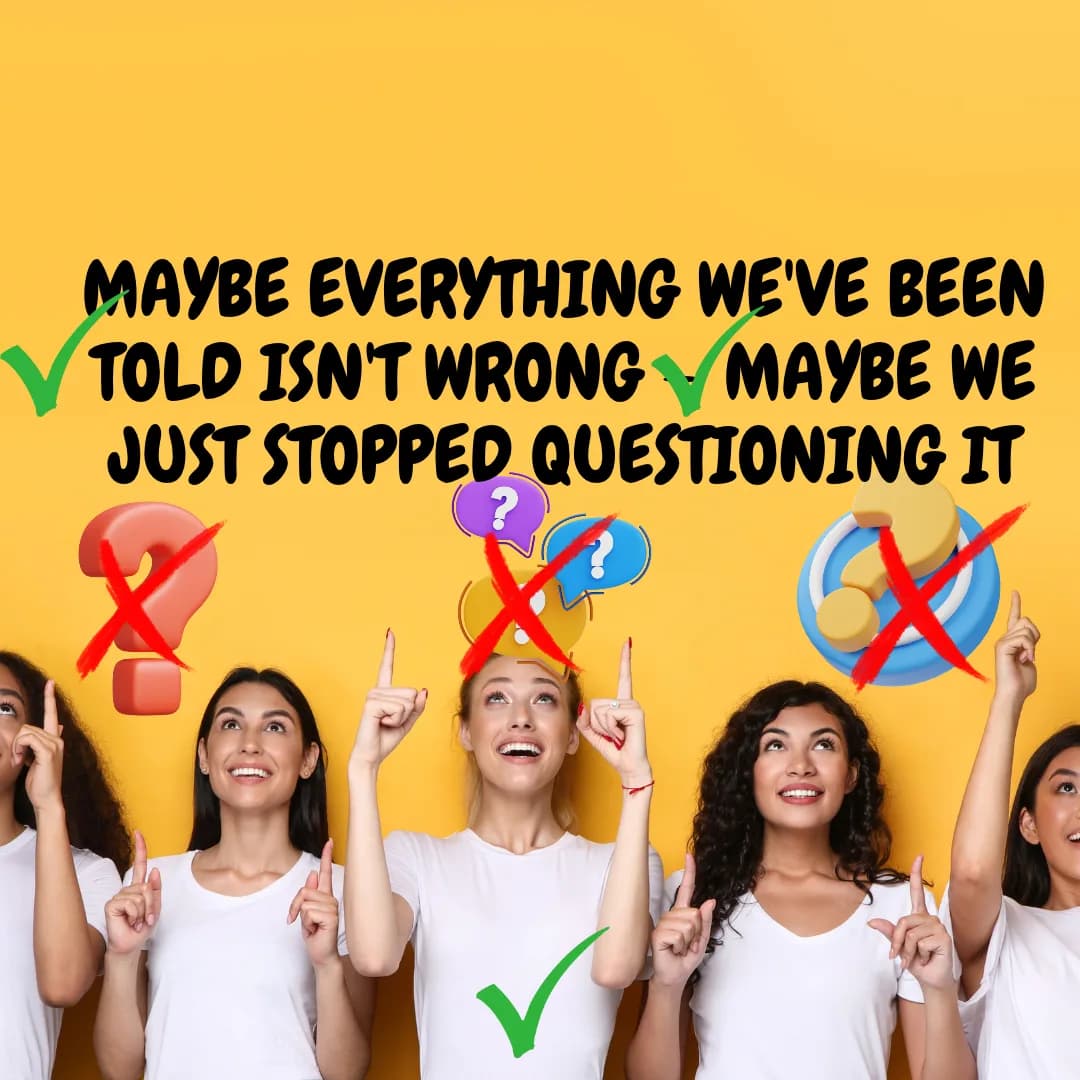
Things We Probably Need to Rethink
On this blog we have looked at many things we were told: that everything happens for a reason, that you should follow your passion, that hard work always pays off, that money cannot buy happiness.
Some of them were wrong. Some were half true. A few were right. And that is exactly the point.
Look at the words of the year: “authentic” (Merriam-Webster 2023), “polarization” (2024), “slop” (2025) and “rage bait” (Oxford 2025). Together they read like a diary of a world asking one question: what can we trust?
10-SECOND VERSION: In a famous experiment, about 75% of people went along with a clearly wrong group at least once but when just one person disagreed, almost everyone found their voice.
With one ally who gave the right answer, going along with the wrong group fell from about 37% to about 5%.
What People Say....
If everyone says it, it must be true. And if everyone says it is wrong, it must be wrong. I say, is it just me?
Research
In the 1950s, psychologist Solomon Asch asked 123 American male students to match the length of lines. It was an easy task, until a group of actors, sitting with them, all gave the same wrong answer.
About 37% of the real participants' answers followed the wrong majority. About 75% of the participants went along with the group at least once, and about 25% never did. Many said afterwards that they went along to avoid standing out, or because they thought that their own eyes must be wrong. And when just one other person gave the correct answer, going along with the group fell to about 5%.
The goal is not to doubt everything. The goal is to check and then decide.
Question what you were told!
There are two lazy habits. One is to believe everything we were told. The other is to believe the opposite of everything we were told. Both save us the work of checking.
Across this blog, the answer was almost never “the saying is true” or “the saying is false.” It was usually “it depends, and here is on what.”
Like, "do the right thing" Right for who?
Experience
A woman grew up hearing “never give up.” After reading the research, she sees that it is good advice for some goals and bad advice for others. She does not throw the saying away. She learns when it applies.
My Question
Which belief have I never questioned, and what would I need to check it?
On the Other Hand
Questioning everything is exhausting and impossible. We need trust to live. Much of what we know, for example, that the Earth goes around the Sun, has already been checked by many people.
Healthy questioning is proportional: check more when the stakes are high and the claim is surprising. And single studies, including the ones in this blog, can be revised or fail to replicate, as we saw with growth mindset.
The Stark Reality - Truth
The best honest ending I can offer. Many things we were told are right. The danger is not belief. The danger is believing without ever checking.
The Significance
What does it promise? That the crowd, or the opposite of the crowd, knows best.
What does the evidence show? That most people go along with a wrong group at least once and that one honest dissenter can change that.
What should you do? Ask: What is the evidence? Who is missing? What would change my mind?
Be Brave.
This is the closing question for the whole blog: what is one thing you were told that you will now check for yourself?
Frequently Asked Questions
What was the Asch conformity experiment?
In the 1950s, Solomon Asch tested whether people would give a clearly wrong answer to match a group. About 37% of answers followed the wrong group, and about 75% of participants went along at least once.
Why do people conform?
Studies suggest two main reasons: wanting to fit in and avoid rejection, and believing that the group might know better.
How can I question things without becoming cynical?
Check important claims with reliable sources, ask “What is the evidence?” and “Who is missing?”, and stay open to being wrong, both about the claim and about your own doubts.
Does questioning everything make you smarter?
Not by itself. Good questioning is selective and humble. Constant doubt is as lazy as constant belief.
English Lesson: Questioning with Confidence
Every article on this blog is also an English lesson. Read slowly, say the new words out loud, and use them today.
New Words
conform (verb) means to behave in the same way as other people. Many people conform to avoid standing out.
dissent (noun / verb) means to disagree openly. One voice of dissent changed the vote.
assumption (noun) means something you accept as true without checking. That is a big assumption.
challenge (verb) means to question whether something is true or right. She challenged the idea politely.
verify (verb) means to check that something is true. I verified the numbers before I shared them.
independent (adjective) means thinking or acting for yourself. He is an independent thinker.
Say This, Not That
Say “What's the evidence for that?”
Don't say “Everyone knows that.”
Why? “Everyone” is not evidence.
Say “I disagree, and here's why.”
Don't say “Whatever, I'll go along with it.”
Why? Calm disagreement with a reason helps the whole group.
Say “I used to believe that, but I checked.”
Don't say “I never change my mind.”
Why? Changing your mind after checking is a strength.
Grammar Spotlight: question tags
A question tag is a short question at the end of a sentence. We use it to check something or to invite agreement.
Positive sentence + negative tag: It's true, isn't it?
Negative sentence + positive tag: They don't know, do they?
Use the same auxiliary verb: You checked the source, didn't you?
Common mistake: Use the same auxiliary, in the opposite form.
Incorrect: You checked the source, don't you?
Correct: You checked the source, didn't you?
Quick Practice
It's a good idea, ___? (isn't it / is it)
You checked the source, ___? (didn't you / don't you)
They don't agree, ___? (do they / don't they)
Answers: 1. isn't it · 2. didn't you · 3. do they
You finished the whole blog series! Which lesson changed your thinking most?
Enjoyed this lesson? Subscribe to English with Sue and become an active student. Every article gives you new words, useful phrases and one grammar point. Today's challenge: write one sentence with a new word and say it out loud.