Things We Probably Need to Rethink
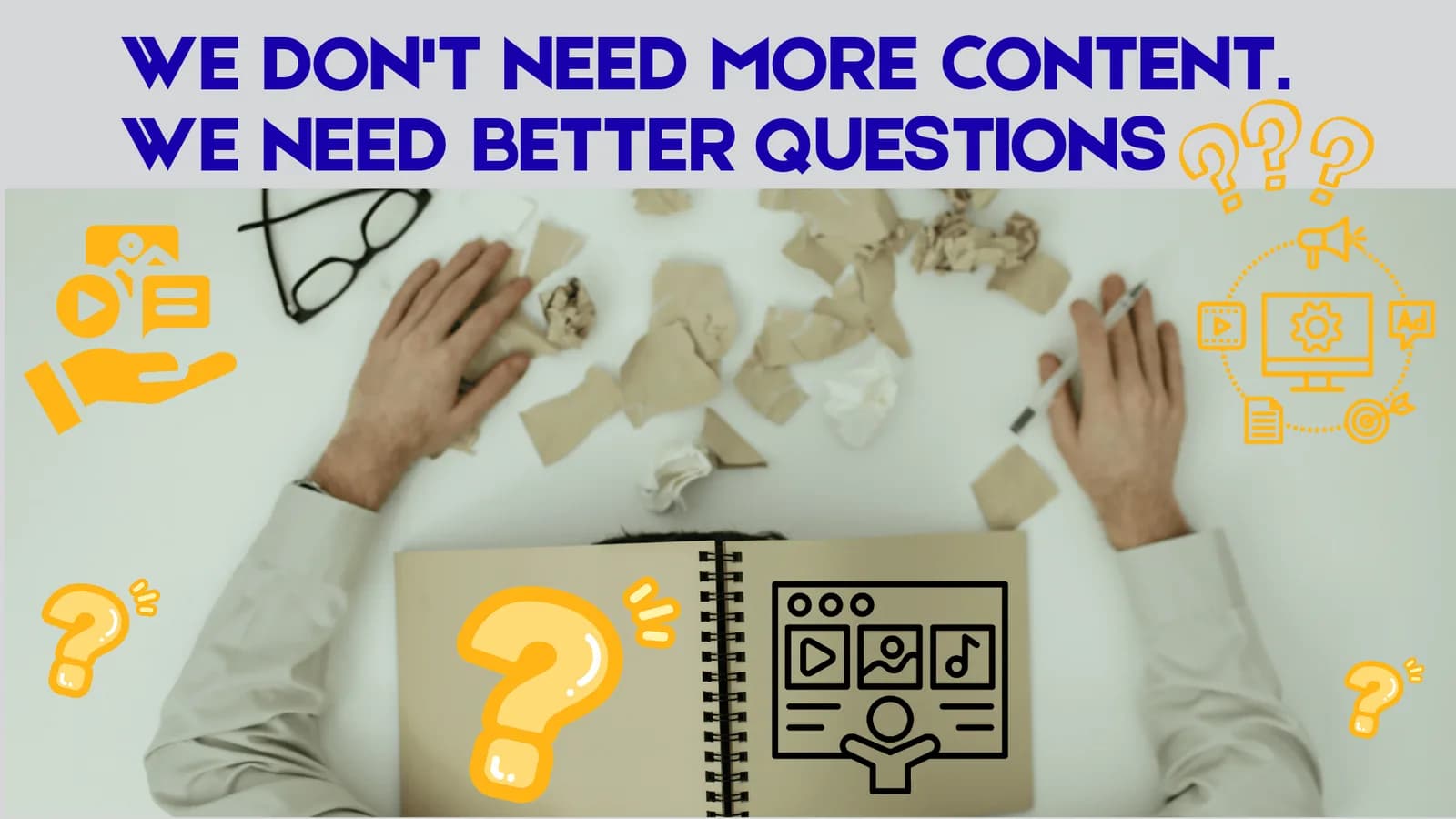
New videos, new posts, new headlines: your feed never ends. But when did you last ask yourself a really good question, and wait for the answer?
Oxford chose “rage bait” as its 2025 Word of the Year: online content made to provoke anger and drive clicks. Oxford said use of the term tripled in one year. When feeds are full of outrage, the questions we ask matter more than the content we consume.
10-SECOND VERSION: Harvard researchers found that people who ask more questions, especially follow-up questions, are better liked. And most of us do not expect that.
Speed daters who asked more questions were more likely to get a second date.
What People Say....
We need more information, more content and more answers.
Research
In 2017, Karen Huang, Alison Wood Brooks, Francesca Gino and their colleagues at Harvard studied question-asking in three studies of live conversations and in face-to-face speed dating. They found that people who ask more questions are better liked by their conversation partners.
The effect came mainly from follow-up questions, which show that you are listening, understanding and caring (the researchers call this “responsiveness”). In speed dating, people who asked more questions were more likely to get a second date. And the researchers found something surprising: people do not expect that asking questions will make others like them more.
A follow-up question says: I was really listening.
We Know This!
We treat the internet as a place for answers and opinions. But answers without good questions are just noise. Rage bait works because it gives you a reaction, not a question.
This is my opinion, and I know that it is a simple one.
Experience
Two friends meet. One tells a long story about her week. The other says, “That sounds exhausting. What was the hardest part?” She smiles for the first time all evening.
My Question
What is one question I have been afraid to ask myself or someone else?
On the Other Hand
Questions are not magic. A badly chosen question, one that sounds like a trap or an interrogation, can hurt. The research above is about conversations and dating, not about news or social media content. And sometimes we do need answers: facts, instructions, help.
The point is not “questions instead of content.” It is a better balance.
The Stark Reality - Truth
We have more than enough content. What is often missing is curiosity, and the follow-up question is one of the simplest ways to show it.
The Significance
What does it promise? That the answer to every problem is more information.
What does the evidence show? That people who ask more questions, especially follow-up questions, are better liked.
What should you do? Listen first, then ask one follow-up question before you share your own story.
Be Brave.
In your next conversation, ask three follow-up questions before you share your own story.
Frequently Asked Questions
What is a follow-up question?
It is a question that builds on what the other person just said, for example: “You said the trip was stressful, what was the hardest part?”
Does asking questions make people like you?
In studies by Huang and colleagues, people who asked more questions, especially follow-up questions, were better liked by their conversation partners.
What is rage bait?
It is online content that is deliberately designed to make you angry, to increase clicks and engagement. Oxford named it Word of the Year for 2025.
How can I ask better questions?
Be curious, listen first, ask open questions that begin with how, what or why, and ask one follow-up before you move on.
English Lesson: Asking Better Questions
Every article on this blog is also an English lesson. Read slowly, say the new words out loud, and use them today.
New Words
curious (adjective) means wanting to know or learn something. Children are naturally curious.
follow-up question (noun phrase) means a question that continues from the last answer. She asked a follow-up question about his trip.
responsive (adjective) means reacting in a helpful way to what someone says or needs. A responsive listener makes you feel heard.
rage bait (noun) means online content made to make people angry. That headline is pure rage bait.
engagement (noun) means likes, comments, shares and time spent with content. Angry posts often get more engagement.
outrage (noun) means a very strong feeling of anger. The post caused public outrage.
Say This, Not That
Say “Could you tell me more about that?”
Try not to say “Why would you do that?”
Why? The first question invites a story. The second sounds like criticism.
Say “What was the hardest part?”
Try not to say “Was it hard?” (only yes or no)
Why? Open questions give people room to talk.
Say “I'm curious — how did you decide?”
Try not to say “That's a strange decision.”
Why? Curiosity opens a door. Judgment closes it.
Grammar Spotlight: indirect questions
For polite or careful questions, we use an indirect question. The word order is like a statement: subject + verb. We do not use do / does / did.
Direct: What time does it start? - Indirect: Could you tell me what time it starts?
Direct: Where is the station? - Indirect: Do you know where the station is?
I wonder why she left.
Common mistake we make
Not: Could you tell me what was the problem?
Definitely: Could you tell me what the problem was?
Quick Practice
Do you know where ___? (is the station / the station is)
Could you tell me what time ___? (does it start / it starts)
Fix the mistake: I wonder why did he leave.
Answers: 1. the station is · 2. it starts · 3. I wonder why he left.
Enjoyed this lesson? Subscribe to English with Sue and become an active student. Every article gives you new words, useful phrases and one grammar point. Today's challenge: write one sentence with a new word and say it out loud.