Money & Success
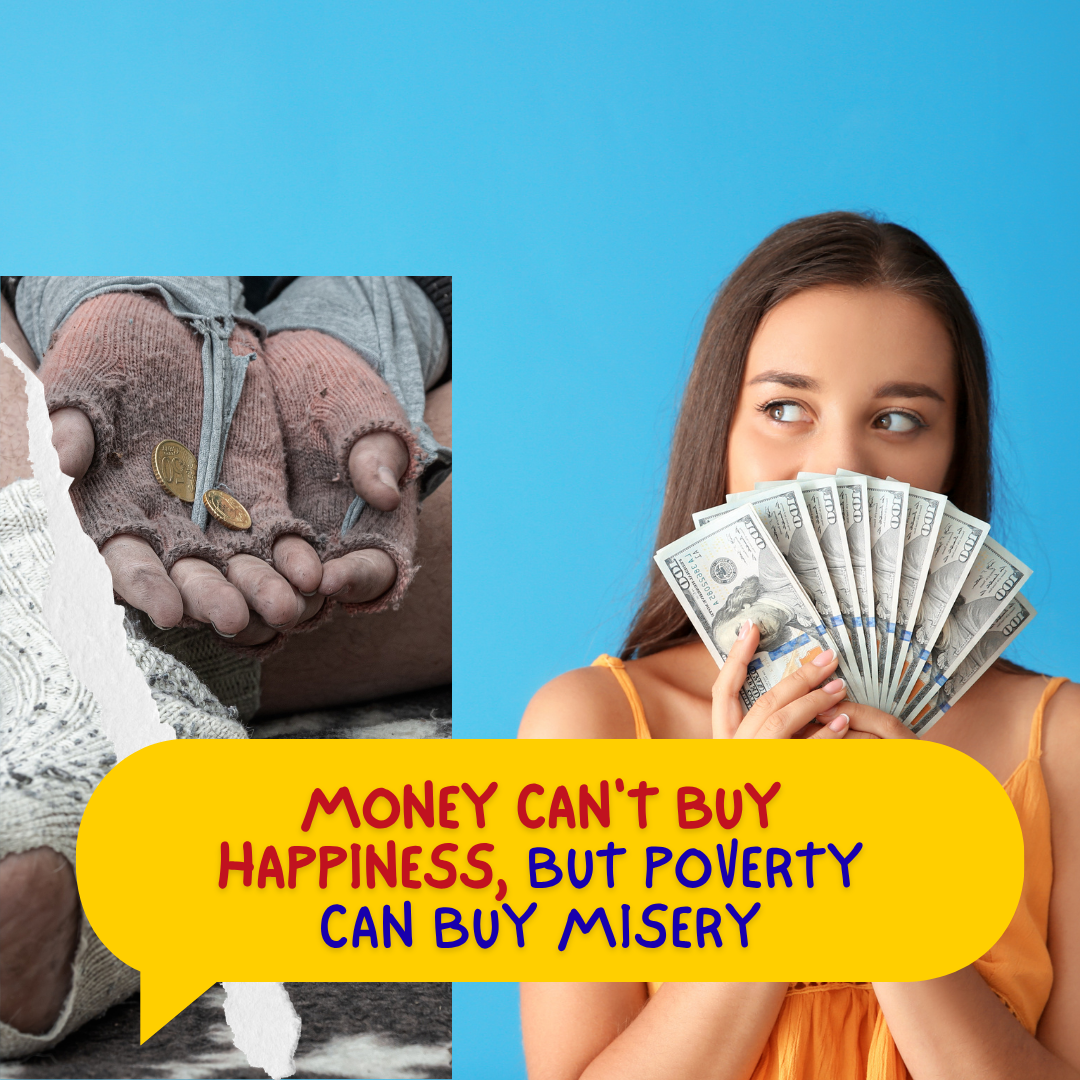
Money Can't Buy Happiness - But Poverty Can Buy Misery
Money & Success
Rent goes up. Groceries cost more. Your pay stays the same. And someone online says, “Money can't buy happiness.”
Easy to say when your bills are paid. So what does the research really say?
TRENDING NOW: For the third year in a row, over 9 in 10 workers say their wages are not keeping up with the cost of living, according to Monster's 2026 Cost of Living Report. And in a Credit Karma survey, 27% of Americans said they “doom spend”, they shop to cope with money stress.
10-SECOND VERSION: For most people, more money really does go with more happiness. But money cannot fix every kind of unhappiness.
For about 8 in 10 people, happiness keeps rising with income, even above $100,000.
What People Say....
Money can't buy happiness. After you have enough, more money changes nothing.
Research
For years, a famous 2010 study by Daniel Kahneman and Angus Deaton said that day-to-day happiness stopped rising at about $75,000 a year. In 2021, researcher Matthew Killingsworth tested the question in a new way. He used a phone app to ask people how they felt, many times during the day. He found no stop at $75,000.
In 2023, the two sides wrote one paper together, with Barbara Mellers. They studied more than 33,000 working adults. Their answer: for most people (about 80%), happiness keeps rising with income. But for an “unhappy minority” (about 20%), happiness rises only up to around $100,000, and then it stops.
At lower incomes, the unhappiest people gained the most from extra money.
The Usual Blah, Blah, Blah
“Money can't buy happiness” sounds wise. But it is often said by people who are not worried about rent. When you worry every month about paying bills, money is not a fantasy. It is daily stress.
This last part is my reading of the research, not a study result. But see if it matches your life.
Experience
Imagine two people who both say, “I'm so stressed.” One is stressed because the electricity bill is late. The other is stressed because her work feels meaningless, even though she is comfortable. The word is the same. The problem is not.
My Question
If money fixes some kinds of unhappiness but not all of them, which kind do you have?
On the Other Hand
These studies use surveys about feelings. That is not the whole picture of a good life. They also show a link between money and happiness, not proof that money causes it. And for the unhappy minority, more income stopped helping after about $100,000.
Killingsworth himself summed it up: money is not the secret to happiness, but it probably helps a bit.
The Stark Reality - Truth
Mostly misleading. Money cannot fix every problem. But for most people, more money goes with more unhappiness, and for people who are struggling, extra money seems to help the most.
The Significance
What does it promise? That money has no effect on happiness after a certain point.
What does the evidence show? That for about 80% of people, happiness keeps rising with income, and for the unhappy minority it stops at around $100,000.
What should you do? Ask what you want money to do: remove worry first, then give you time and choices.
Be Brave.
If you had $500 more every month, which problem would it solve, and which problem would stay?
This is my take, my truth, it would solve some, but I would constantly need more. That is human nature.
Frequently Asked Questions
Does more money make you happier?
For most people, yes, on average. In a 2023 study of more than 33,000 working adults, happiness kept rising with income for about 80% of people.
Is there a salary where happiness stops rising?
Not for most people. For an unhappy minority (about 20%), the benefit stopped at around $100,000 a year.
Can you buy happiness by spending money on time?
Research by Ashley Whillans found that people who spend money to save time report higher life satisfaction. We look at this in Part 5 of this series.
Why do I feel stressed about money even when I earn more?
Stress habits matter as well as income. For example, in a Credit Karma survey, 27% of Americans said they doom spend to cope with stress. A bigger income does not automatically fix a stress habit.
English Lesson: Talking About Money and Feelings
Every article on this blog is also an English lesson. Read slowly, say the new words out loud, and use them today.
New Words
income (noun) means the money you receive, for example from work. Her income is higher this year.
afford (verb) means to have enough money to buy something. We can't afford a new car.
plateau (noun / verb) means a level where growth stops. Sales reached a plateau.
poverty (noun) means the state of being very poor. Many families live in poverty.
well-being (noun) means how happy and healthy you feel. Money worries affect our well-being.
wealthy (adjective) means having a lot of money. He comes from a wealthy family.
Say This, Not That
Say “I can't afford it right now.”
Don't say “I'm too poor for that.”
Why? The first sentence describes the situation now. The second labels you as a person.
Say “That's outside my budget this month.”
Don't say “That's way too expensive!” (to a seller)
Why? The first sentence talks about your limit. The second criticizes the price.
Say “I'm worried about the cost of living.”
Don't say “I'm broke, so I'm a failure.”
Why? Money problems are not a character problem.
Grammar Spotlight: as ... as / more ... than
as + adjective + as = equal. Time is as valuable as money.
not as + adjective + as = less. My salary isn't as high as hers.
more + adjective + than = a difference. Rent is more expensive than food.
Common mistake: Do not mix as and than.
Incorrect: He earns as much than me.
Correct: He earns as much as me.
Quick Practice
He earns as much ___ I do. (as / than)
Rent is ___ expensive than food. (more / as)
Fix the mistake: She isn't as rich than her sister.
Answers: 1. as · 2. more · 3. She isn't as rich as her sister.
Enjoyed this lesson? Subscribe to English with Sue and become an active student. Every article gives you new words, useful phrases and one grammar point. Today's challenge: write one sentence with a new word and say it out loud.